When discussions turn to the memorization of math facts, opinions are often strong. Many adults recall their own childhood experiences with timed drills and flashcards, and those memories—combined with evolving views on educational best practices—frequently spark debate.
A widely discussed article by Dr. Paul L. Morgan in Psychology Today examined research conducted alongside colleagues George Farkas and Steve Maczuga at Penn State. Their study investigated first-grade mathematics instruction and student achievement. At first glance, their findings might seem to challenge student-centered learning. However, looking closely at how Montessori materials actually work reveals that our methodology directly aligns with the study's conclusions about the necessity of direct instruction, structured practice, and automaticity.
Understanding the Research Findings
Dr. Morgan and his team observed a variety of first-grade classrooms to measure the impact of different instructional approaches on math achievement. They noted that student progress was strongest when learning included structured, teacher-directed instruction rather than unstructured, open-ended exploration alone.
The researchers defined teacher-directed instruction as an approach where:
"Teachers initially demonstrate specific procedures for solving problems, and then provide students with repeated opportunities... to independently practice these procedures. Teacher-directed practices should help students increase their procedural fluency... which should result in more effective use of higher order thinking and problem-solving skills."
To those unfamiliar with authentic Montessori environments, it might be easy to assume our approach relies solely on open-ended student choice without explicit guidance. In reality, the step-by-step presentation of materials by a Montessori guide—followed by independent, repeated practice—fits this exact definition of targeted skill development.
Choice Within Limits: How Montessori Guides Math Fluency
A common misconception about Montessori education is that children choose whatever they want to do without structure. In our classrooms at The T.E.C. Schools—from Children's House through Lower Elementary—learning operates under the core principle of freedom within limits.
Montessori guides do not simply leave children to figure out mathematics independently. Instead, we deliver direct, precise lessons on how to use each concrete material. Once a child understands the procedure, they are given explicit expectations for daily, independent practice.
While building a conceptual understanding of why numbers work is foundational, gaining automatic recall of basic facts (addition, subtraction, multiplication, and division) is equally essential. When basic math facts become automatic, children free up working memory to tackle multi-step, complex operations with confidence.
Concrete Materials That Build Fact Recalls
In our Lower Elementary classrooms, math shelves are stocked with scientifically designed materials that guide children from tactile discovery to speed and accuracy:
- The Bead Cabinet & Bead Chains: Introduced as early as age 3 or 4 in Children's House, skip-counting with bead chains helps children visualize numbers in linear and geometric forms. By the time students reach Lower Elementary, this familiar practice transitions seamlessly into multiplication table recall.
- Addition and Subtraction Strip Boards: Introduced around ages 5 to 6, these boards allow students to explore number combinations physically. As children work through equations, they recognize patterns and naturally build speed.
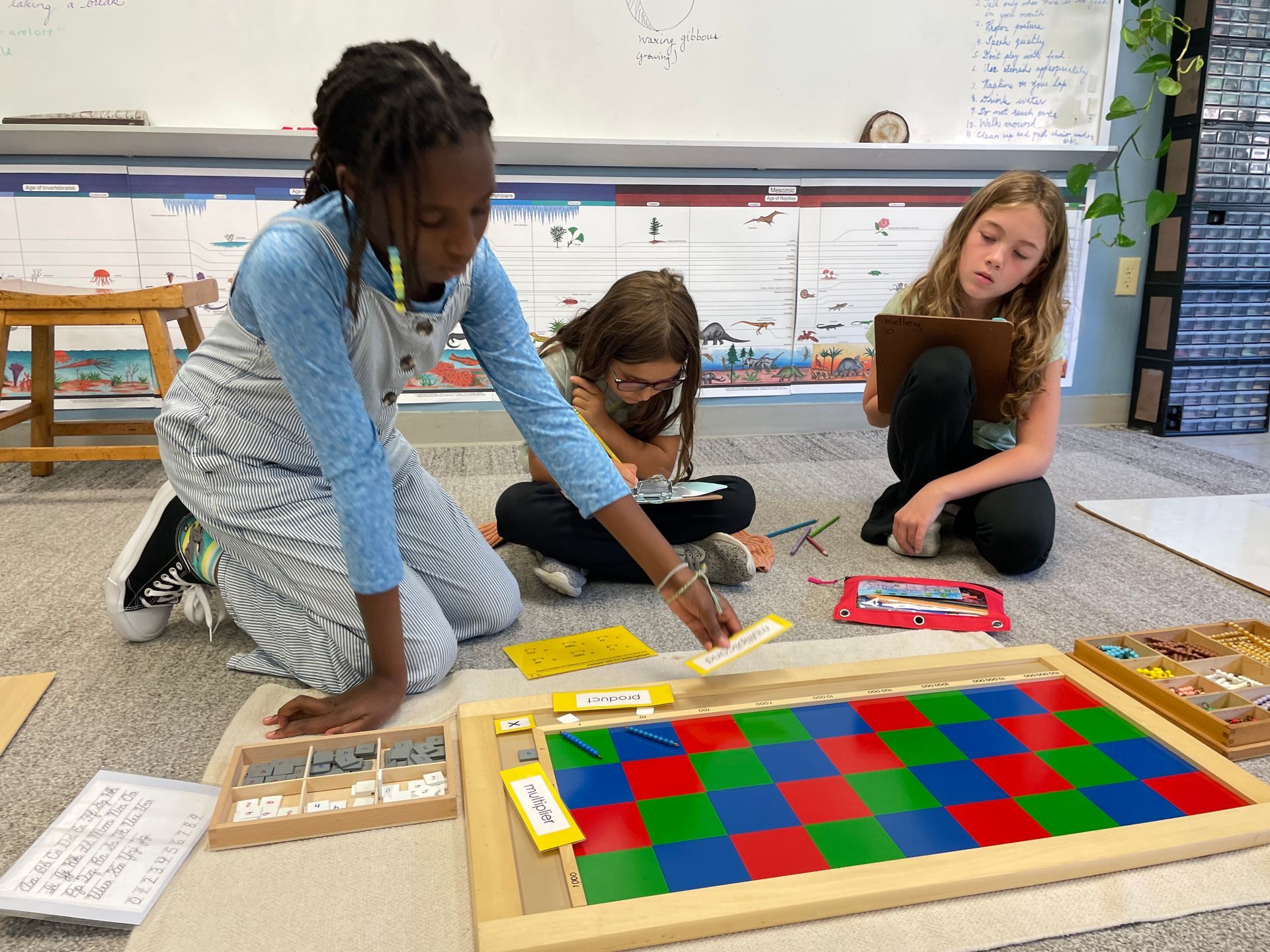
- Multiplication and Division Bead Boards: Similar to the strip boards, these materials give abstract mathematical concepts a physical representation. Students manipulate beads to understand arrays and fair sharing before moving toward mental calculation.
- Finger Boards: Wooden counterparts to traditional fact charts, finger boards encourage daily practice across all four operations. Immediate feedback is provided through self-correcting Control Charts, allowing children to check their own work accurately without relying on adult intervention.
- Recorded Practice: Blackline masters and math journals accompany these physical materials, ensuring children write down equations and reinforce recall through physical writing.
Targeted Assessment and Personalized Practice
Building math fluency requires monitoring progress to ensure practice remains purposeful. In our classrooms, guides conduct brief, one-on-one assessments with students to identify which facts are mastered and which require further practice.
By tracking fluency systematically, guides help students focus their independent work on the specific number combinations they have not yet memorized. This targeted approach prevents wasted time on already-mastered facts and keeps students motivated as they observe their own growth.
Fostering Analytical Thinkers in Worcester
When concrete understanding is paired with structured, targeted practice, children develop both speed and deep conceptual clarity. This combination allows students across our Lower Elementary, Upper Elementary, and Middle School programs to approach higher-level mathematics with enthusiasm and self-assurance.
By encouraging children to Think critically about mathematical relationships, Explore through tactile materials, and Create personal pathways to problem-solving, we build a solid foundation for lifelong academic success.
Interested in seeing how our math curriculum works in person?
We invite prospective families to
schedule a tour of our campus in Worcester, MA, to observe our prepared learning environments in action.